Making Deep Learning Faster: Quantization Benchmarks with TensorRT
Introduction
Modern deep learning models are typically trained using FP32 (32-bit floating-point precision) to ensure numerical stability and maximum accuracy. However, when deploying these models in production, FP32 inference is often inefficient, leading to higher latency, increased memory consumption, and lower throughput.
To address these limitations, quantization is widely used to reduce numerical precision during inference. In this article, we analyze and benchmark FP32, FP16, and INT8 inference using NVIDIA TensorRT, with a focus on performance trade-offs and deployment considerations.
Quantization in Deep Learning Inference
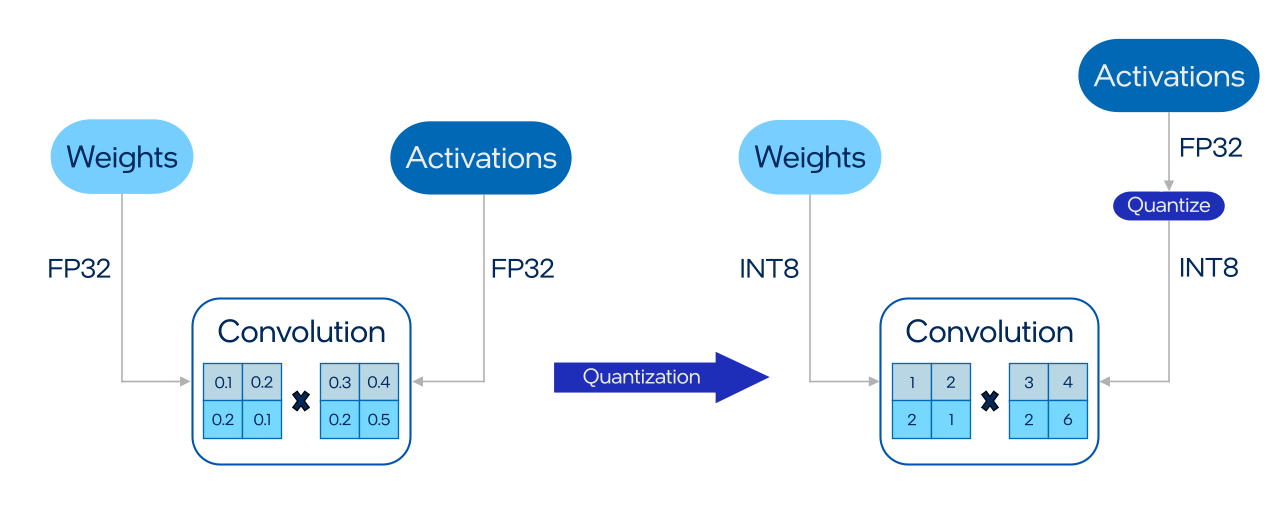
Quantization is the process of converting high-precision numerical representations into lower-precision formats while attempting to preserve model accuracy.
The main objectives of quantization are:
- Reducing memory bandwidth usage
- Increasing inference throughput
- Lowering latency
- Improving hardware utilization
- Reducing power consumption
TensorRT applies quantization during engine build time, generating hardware-optimized inference engines tailored to the target GPU architecture.
Precision Formats Explained
FP32 (Full Precision)
FP32 is the standard precision used during training. It provides:
- High numerical accuracy
- Strong stability during backpropagation
However, during inference it suffers from:
- High memory usage
- Lower computational efficiency
- Slower inference speed
FP32 is typically reserved for training or accuracy-critical inference.
FP16 (Half Precision)
FP16 reduces the precision of floating-point values to 16 bits. On modern NVIDIA GPUs, FP16 operations are accelerated using Tensor Cores.
Key properties:
- Significant speedup compared to FP32
- Minimal or no accuracy loss for most models
- Reduced memory footprint
FP16 is often the default choice for production inference.
INT8 (Integer Quantization)
INT8 quantization converts weights and activations to 8-bit integers. This approach requires additional steps to preserve numerical accuracy.
Characteristics:
- Lowest memory usage
- Highest throughput
- Lowest inference latency
Trade-off:
- Potential accuracy degradation if not carefully calibrated
INT8 is ideal for high-throughput, latency-sensitive applications.
ONNX in the Deployment Pipeline
 ONNX (Open Neural Network Exchange) is a framework-agnostic intermediate representation for deep learning models. It defines a standardized computational graph, allowing models to be exported from training frameworks and consumed by inference runtimes.
ONNX enables:
- Model portability
- Cross-framework compatibility
- Runtime-level optimization
TensorRT natively consumes ONNX models, making it the preferred format for optimized GPU inference.
Quantization Strategies
There are two primary strategies for applying INT8 quantization:
Post-Training Quantization (PTQ)
Post-Training Quantization (PTQ) applies quantization after model training, without modifying weights.
Technical process:
- Run a calibration dataset through the model
- Collect activation statistics
- Compute scaling factors
- Map floating-point tensors to INT8 ranges
Why 8-bit post-training quantization:
The 8-bit quantization is just one of the available compression methods but one often selected for:
- significant performance results.
- little impact on accuracy.
- ease of use.
- wide hardware compatibility.
Advantages:
- No retraining required
- Fast deployment
- Low engineering complexity
Limitations:
- Accuracy depends heavily on calibration data
- Less effective for deep or sensitive models
PTQ is suitable when training data is unavailable or rapid deployment is required.
Quantization-Aware Training (QAT)
Quantization-Aware Training (QAT) integrates quantization effects directly into the training process.
Technical process:
- Insert fake quantization operators
- Simulate INT8 arithmetic during forward passes
- Adjust weights via backpropagation
Advantages:
- Higher INT8 accuracy
- Reduced quantization error
- More stable activation distributions
Limitations:
- Requires retraining
- Increased training complexity
- Higher computational cost
QAT is preferred for accuracy-critical production systems.
TensorRT and Quantization Workflows
TensorRT supports both PTQ and QAT through ONNX-based workflows.
PTQ Workflow
- Train model in FP32
- Export model to ONNX
- Apply INT8 calibration in TensorRT
- Deploy optimized INT8 inference engine
QAT Workflow
- Train model using quantization-aware training
- Export quantized model to ONNX
- TensorRT preserves quantization scales
- Deploy high-accuracy INT8 engine
Performance Metrics
Inference performance is evaluated using two primary metrics:
Latency (ms):
Time required to process a single input sample.Throughput (FPS):
Number of inferences processed per second.
Typical trends observed in benchmarks:
- FP32 → Highest latency, lowest throughput
- FP16 → Balanced performance and accuracy
- INT8 → Lowest latency, highest throughput
Key Takeaways
- Quantization is essential for efficient inference deployment
- ONNX enables seamless integration with TensorRT
- FP16 provides an excellent speed–accuracy trade-off
- INT8 delivers maximum performance with proper calibration
- QAT achieves superior accuracy compared to PTQ
Conclusion
Quantization, when combined with ONNX and TensorRT, enables deep learning models to achieve production-level performance without sacrificing reliability. Understanding the trade-offs between FP32, FP16, and INT8, as well as choosing the appropriate quantization strategy, is a critical skill for modern AI engineers.